Security by Design for Analytics Platforms: What Changes When Your Users Face State-Level Threats
Most security reviews of an analytics platform ask what happens if the data leaks — fines, headlines, an awkward quarter. For some organizations the sharper question is what happens to their users, because reading or sharing the wrong content can put a person in prison. Here is how that changes the architecture, pattern by pattern.
Picture the kickoff of a data project. An organization wants to understand how its offering is used: what reaches whom, what works, what doesn’t, where to invest next. The plan is exactly right — consolidate usage data from a handful of source systems onto one analytics platform, build data products on top, give decision-makers numbers instead of assumptions. Somewhere in the architecture document there is a security chapter, and it says what security chapters usually say: encryption, backups, access control, GDPR.
For most companies that chapter is about the organization’s risk. If the data leaks, there is a fine, a headline, an uncomfortable board meeting. Painful — and survivable.
Now change one assumption: your users can go to prison for using your product.
That is not a thought experiment. There are countries where reading independent journalism, or sharing it, is a criminal offense. For an organization whose mission is to reach exactly those people, a log line that connects a person to a piece of content is not a usage metric. It is potential evidence. And the moment you build a platform that aggregates those log lines, you have changed your own threat model — whether you noticed or not.
I thought I knew this problem. I knew half of it.
I have spent a large part of my career in and around newsrooms. In environments like Al Jazeera shortly after 9/11, the Guardian shortly after the Snowden publications, or the Frontline Club in London, source protection is simply part of the craft. Nobody debates whether the identity of a whistleblower deserves architectural attention; the systems, the processes, sometimes the building itself are designed around it.
Now imagine that, in addition to protecting your sources, protecting your audience becomes just as important. Not the few people who bring you information, but the many who consume it — who may need protection from their own governments. I’ll be honest: the first time that thought lands — that an organization’s own analytics could be the very thing that endangers the people it wants to reach — it is deeply unsettling. It is also, once you see it, obviously an architecture problem.
And it is not a media-only problem. The same class applies to NGOs, to health platforms, to any service where the usage data alone incriminates, exposes, or endangers the user. The public breaches that make this vivid are rarely the ones where the product database was cracked — they are the ones where an analytics environment leaked, and suddenly the most sensitive fact about millions of people was not a password but a usage history.
The question nobody at the table wants to ask
Here is the moment I think every architect of an aggregation platform should force: you are consolidating data from many source systems into one place, precisely because having it in one place is valuable. Then ask, out loud:
“Are we ourselves now the security risk?”
Because the answer is usually yes. An analytics platform is, by design, a concentration of exactly the information an adversary would otherwise have to collect system by system, breach by breach. Each source system holds a fragment; your platform holds the joined picture. For an attacker, it may be both more attractive and easier to take the aggregate than to take any single source. You built the platform because aggregated data is more valuable — you don’t get to be surprised that adversaries agree.
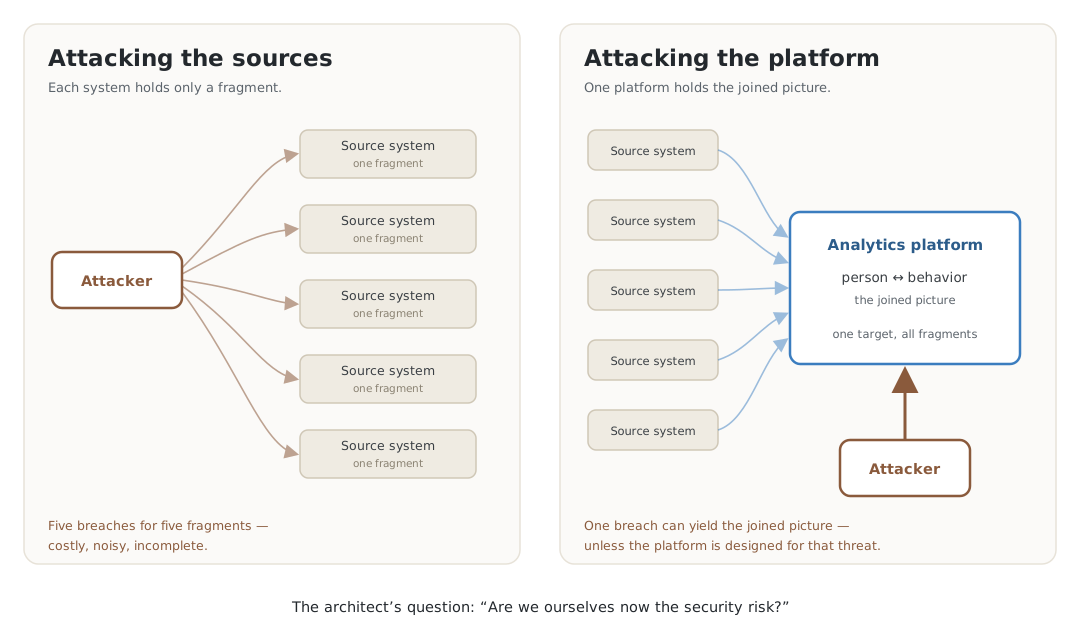
This is why the work has to start with a threat model rather than a toolbox. And the single most consequential line in that threat model is who the adversary is. A commercial data thief wants data they can monetize, cheaply, and moves on when you are expensive to attack. A state is a different opponent: patient, well-resourced, with legal instruments as well as technical ones, and interested in specific people. When the adversary changes from “someone who wants data” to “someone who wants your users,” the crown jewel changes too. It is not the product data, not the revenue numbers — it is the link between a person and their behavior. Every design decision that follows is about making that link scarce, coarse, or nonexistent.
Data minimization is an architecture decision
Every data organization says it practices data minimization, because the GDPR obliges it to. In most places that means a retention policy document and a yearly audit. Under a state-level threat model, minimization moves from the compliance annex into the architecture itself, as three design rules:
- Collect only what current analyses need. Not what might be useful someday — that “someday” pile is precisely the asset an attacker wants and a court can compel. If no data product needs it today, it is not collected today. Collection follows demand, not hope.
- Persist even less than you collect. Some questions can be answered in passing — aggregate at the edge, keep the count, drop the event. Everything that lands in storage should have to justify its persistence, not its deletion.
- Avoid personally identifiable information by design. The most effective control is to make the dangerous join impossible: no user accounts in the analytics path where you can avoid them, aggregates instead of individual trails, cohorts instead of profiles.
The test I give every incoming analytics requirement is one question: “Can we answer this without knowing who?” In my experience the honest answer is almost always yes. Product owners and analysts want to know how many, where, how long, which parts of the offering — questions about populations, not persons. The individual-level data that accumulates in most platforms isn’t there because anyone needs it. It is there because collecting it was the default. Security by design, at its core, is changing that default.
There is a satisfying corollary: the safest data is data you never collected. No breach can expose it, no insider can sell it, no legal order can compel it. Minimization is the one security control that cannot fail at 3 a.m.
Design access as if someone is already inside
Whatever you do collect still needs protecting, and here the principle is to assume partial failure. A few patterns carry most of the weight:
- Authorization per data product, not per platform. Access is granted to this data product for this purpose — down to table and column granularity where the data warrants it. The analyst who needs aggregated metrics does not, by that fact, get raw events.
- Global access for no one. Not the platform team, not the admins, not the CEO. If a single account can read everything, that account is the target, and eventually someone will hold it who shouldn’t. “Who can see all of it?” should have the answer: nobody.
- The unglamorous basics, actually done. Two-factor authentication everywhere, encryption at rest, joiner-mover-leaver processes that work. None of this is novel; all of it fails more often through absence than through sophistication.
- Placement as a threat-model decision. Where the platform physically and legally lives — on-premises, in a cloud, in which cloud under which jurisdiction — is not a cost or convenience question when your adversary is a state with legal reach. It is part of the security design, decided with the threat model on the table, not after it.
None of these patterns is exotic. What changes under this threat model is that they stop being nice-to-haves you trade away for delivery speed, because the cost of failure is not measured in fines.
The residual risk is real — say so
And then there is the part that belongs in the architecture document even though nobody enjoys writing it: complete protection is not possible. Endpoints you don’t control, networks you don’t operate, platforms you don’t run — parts of the path between you and your users are simply outside your reach, and a state-level adversary can work on all of them. A residual risk remains, no matter how good the design is.
Saying this out loud is not defeatism; it is the opposite. An architecture that claims full protection will be designed complacently. An architecture that assumes eventual partial failure gets the properties you actually want: a platform where a successful breach yields aggregates instead of identities, where no credential opens everything, and where the most dangerous data was never collected in the first place. You design for the residual risk, not in denial of it.
Security sits at the shared table
Last, the organizational point, because none of the above is a one-time review. Which data may be collected, how long it lives, who may access which data product, where the platform runs — these are exactly the questions I described in Meet Once, Not Twice as belonging at the single, shared governance table, answered once for data and AI together. Security under a serious threat model is not a gate at the end of that process. It is a standing seat at that table — because every new data product, every new analysis, every new AI use case on top of the platform reopens the same question: does this create a new way to link a person to their behavior?
If your users only risk embarrassment, you may get away with treating security as a chapter. If your users risk prison, security is a design partner from the first whiteboard. The good news, having sat through it: the resulting architecture is not slower or poorer. It is leaner — because it stopped collecting what it never needed — and it can answer the question every architect of an aggregation platform should be able to answer: we know we are a target, and here is why that is survivable — for us, and for the people who trust us.