Meet Once, Not Twice: Think Your Data and AI Organization Together
Most companies run their data initiative and their AI initiative as two separate projects, each with its own roadmap, and each booking its own meetings with Security, Legal, and Enterprise Architecture. That duplication is where the time goes. Here is the case for one organization, one governance table, and answering the hard questions once.
Most organizations arrive at data and AI the same way: as two projects. The data initiative starts first: a Data Mesh, a central platform, governance standards, an enabling team, a handful of decentralized domain teams. Some time later the AI initiative arrives on top, usually with its own budget, its own team, and its own operating model. Two initiatives, two roadmaps, two org charts.
And here is the part that quietly costs the most: both of them have to talk to the same cross-cutting teams. The data initiative sits down with Security, Legal & Compliance, Data Governance, Enterprise Architecture, and Portfolio Management to work out which data may be collected, how it must be classified, where it may be stored, and how the whole effort ranks against everything else the company could fund. Then the AI initiative sits down with exactly the same teams to work out which data may be processed with a model, where inference may run, which jurisdiction applies, and how its effort ranks. Same people, same questions, two calendars.
The result is familiar: duplicated meetings competing for the same scarce reviewers; standards that drift apart because they were decided in two rooms; and a time-to-market that grows precisely because every cross-cutting concern is negotiated twice. Yet for any given use case, the data flows and the AI on top of them are steps in one value stream. Splitting them into two governance tracks doesn’t just add overhead. It pulls apart decisions that belong together.
Why they can share one organization
This isn’t a coincidence of scheduling. The two disciplines are structurally the same shape, because they grew up the same way.
Data organizations spent two decades on a pendulum. Analysis started inside operational systems, then moved into a central Data Warehouse to get it off the transactional databases and into one place. Central was good for consistency and broke on knowledge. The central team never understood a domain’s data as well as the domain did. So the pendulum swung back toward the domains and settled, with Data Mesh, on a structured hybrid: domains own their data products, a central platform team offers self-serve infrastructure, and a federated governance forum sets the rules everyone shares.
AI operating models walked the same road, faster. A central ML/AI Center of Excellence played the Data-Warehouse role: scarce specialists, decoupled from the domains, producing models that never fully absorbed the domain knowledge. Hub-and-spoke then embedded those specialists into the business. And when generative AI turned AI into something the business pulled rather than something IT pushed, the central hub stopped acting as a gatekeeper and became a platform-and-enablement function. That is the very same move the central data team made when it became a platform team.
Both fields, independently, converged on one answer: push execution out to the domains, keep the guardrails central as platform and policy, and settle the balance in a federated forum. That shared shape is exactly why one organization can carry both.
But same shape does not mean merge everything. The rule this article argues for is deliberately narrow: thinking together is mandatory; implementing together is a choice you make per use case. You think through the data organization and the AI operating model as one in order to find the synergies. The biggest synergy, the one available on day one regardless of your maturity, is the shared table. (Table as in the wooden one you gather around and knock on for luck, not the one where you keep your rows and columns.)
The integrated model, in one paragraph
Concretely, a single decentralized organization carries both. Domain teams, your existing business domains, own their data products and their AI use cases; they are the spokes. A platform team runs the shared infrastructure, the data platform and the AI platform side by side. An enabling team lends scarce data and AI specialists to domains that need them, and works to make itself unnecessary. And a federated governance forum is where domains, platform, enabling, and the cross-cutting teams settle the rules together. The AI hub-and-spoke model maps onto these four layers almost one-to-one. That is the whole point: there is no second organization to build. This four-layer structure deserves its own deep-dive; here it is enough to see that one shared table carries both.
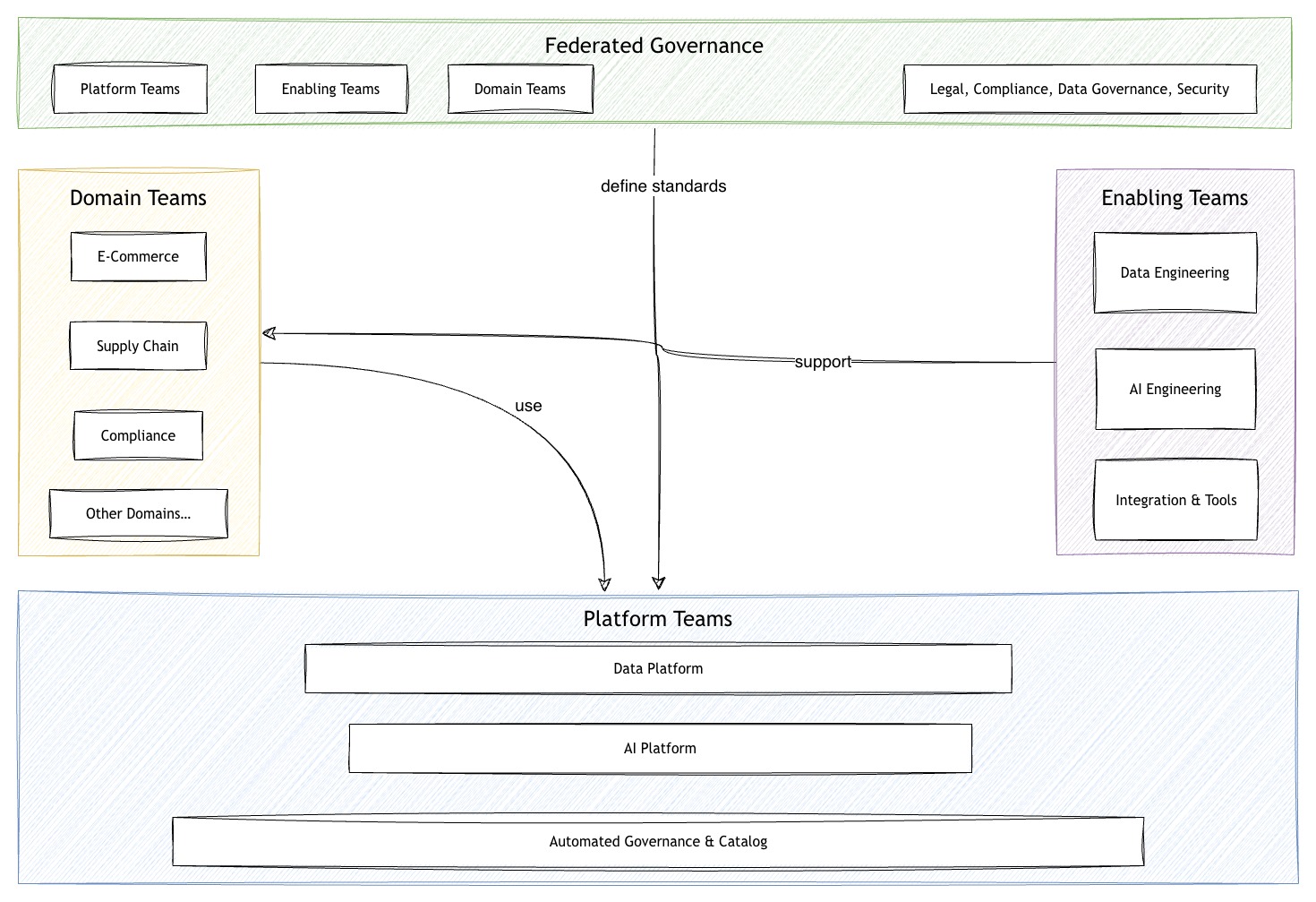
The payoff: one table
Now return to the two calendars from the opening. In the integrated organization there is one governance cadence, not two. Security, Legal & Compliance, Data Governance, Enterprise Architecture, and Portfolio Management sit at the same table as the domain, platform, and enabling teams, and the end-to-end question gets asked once: which data may I collect, which of it may I process with a model, and where must it stay? That is a data-governance question and an AI-governance question at the same time. Answered once, by one body, it comes out consistent. Answered in two rooms, it comes out contradictory, and someone spends the next quarter reconciling the two.
The benefits compound:
- Decisions are made once and stay coherent: no more AI policy that quietly contradicts the data-classification standard.
- The cross-cutting teams see the whole value stream, not half of it, so their review is grounded in what the use case actually does end to end.
- Portfolio management can rank a data-plus-AI use case as one effort against everything else, instead of trying to add up two halves it can’t compare.
- Scarce reviewers are spent once, not booked twice. A good data-protection lawyer or a security architect is a bottleneck you don’t want to double-book.
- Time-to-market shrinks, because the slow part of most use cases isn’t the engineering. It’s the sequence of approvals.
None of this requires the data people and the AI people to become one team. It requires them to share one table.
And for some organizations, one seat at that table carries far more weight than the others: when the usage data itself can endanger the people it describes, security stops being a review step and becomes a design partner. I’ve written about that case, and what it does to an architecture, in Security by Design for Analytics Platforms.
The objections are real, and they set the limit
The integration is not free, and the honest objections are worth stating plainly. An integrated model is harder to explain than two tidy, separate initiatives. Data and AI often move to different rhythms. A solid data foundation is a governance marathon, while an AI win is frequently a quick sprint. Forcing them into lockstep can frustrate both. The two disciplines carry different cultures, skill sets, and speed expectations, and putting them in one room can create friction rather than remove it.
Every one of these is a real argument against implementing everything jointly. Not one of them is an argument against thinking jointly, or against the shared table. So you keep one governance forum and one portfolio view, and you decide, use case by use case, whether a given piece of data-and-AI work is built by one team or two. Where the rhythms clash, you separate the delivery. Where they align, you reap the synergy. The table stays shared either way.
Keep checking
Because this is a balance and not a fixed state, put it on a cadence. Every few months, ask the same three questions:
- Where is thinking together clearly paying off, and should we integrate more tightly?
- Where is it creating friction, and should some delivery run on separate tracks?
- Where have the preconditions changed, such as a new AI initiative or a domain that has matured, so that yesterday’s split is today’s synergy?
These are governance-forum questions, which is fitting: the same table that answers the use-case questions also answers the question of how integrated to be.
Conclusion
The expensive mistake is not choosing Data Mesh or hub-and-spoke. It’s running them as two organizations that meet the rest of the company twice. Both grew from the same root and settle into the same shape; both answer to the same cross-cutting teams; both serve the same end-to-end value streams. Give them one organization and, above all, one table. Then let everyone answer the important questions once.